Management Systems World
All on Quality and other Standards in one place since 2010. Now Worldwide.
Please note that you have to be a registered member with paid membership in order to see full articles.
Register
Quality Managers, Stop Absorbing Dysfunction And Reclaim Your Role
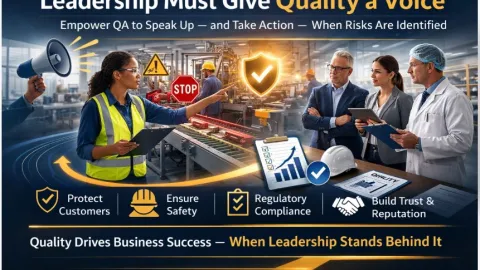
Many quality managers stay too long in environments that do not support strong quality practices, gradually adapting to issues they should be challenging.
Mentoring Could Solve The Auditor Pipeline Problem
The ISO auditing field faces a growing talent pipeline problem as demand for certification rises while fewer new auditors enter the profession.
AI Is Not Just A Tool As It Redefines The Role Of Quality
AI is no longer just a support tool in quality work, as it begins to redefine which tasks matter and what roles are built around.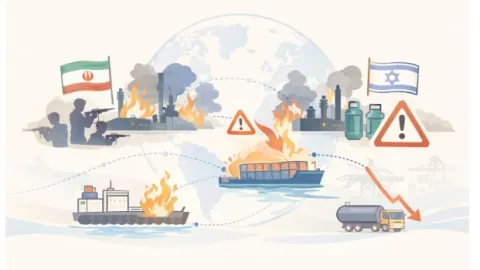
As Geopolitical Risks Rise, ISO 28000 and CTPAT Support Supply Chain Security Governance
Rising tensions in the Middle East are increasing global supply chain risks, exposing vulnerabilities in energy supply, shipping routes, and cross-border trade,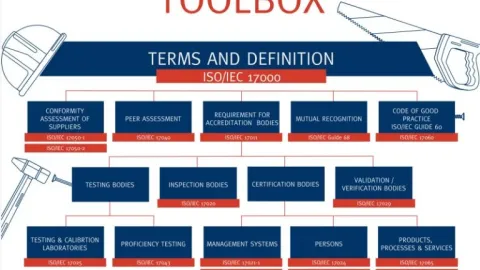
How CASCO Toolbox Helps Structure Global Conformity Assessment
The CASCO toolbox is a set of international standards and guides that regulators use to structure conformity assessment across sectors, covering activities such as testing, inspection, and certification.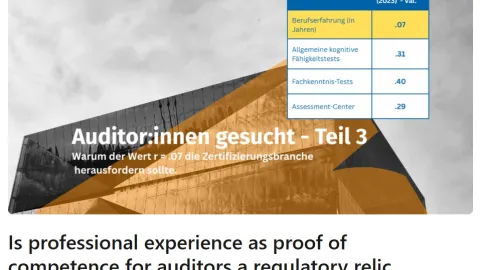
Experience Alone Is Not Proof Of Auditor Competence
Years of work experience may not reliably measure auditor competence, challenging long-standing assumptions in auditor qualification, according to Jörg Westphal, Managing Partner at Hellmund Personalberatung.
Lean Tools Without The Right Culture Create Costly Improvement Theater
When Lean tools are used without the right culture behind them, they can create “improvement theater”, where the appearance of progress hides defects that continue to accumulate and become more expensive to fix downstream.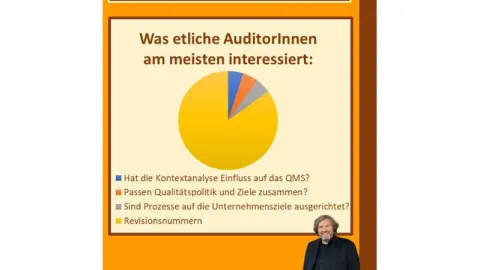
When Auditors Accept A Reduced Role For QMS Real Value Disappears
Quality management systems often bring little real value when their role in organizations is reduced to documentation and formal checks.
Without Process Ownership Quality Teams End Up Solving Every Problem
Quality teams often become overloaded when organizations fail to define clear process ownership.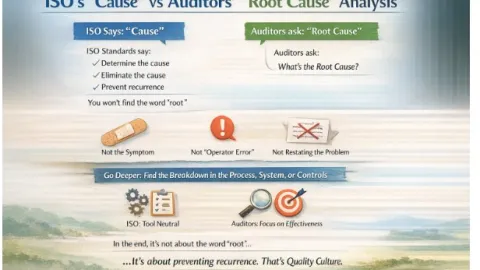
Cause vs Root Cause: Treating Symptoms Or Fixing The Real Problem
ISO management system standards require organizations to determine the cause of problems and eliminate it, yet auditors often ask for a root cause to ensure the underlying issue has been addressed.
Quality Managers Should Never Make These Mistakes Yet Often Still Do
There are things quality managers should never do in a Management Review, yet they still happen regularly, says Ekaterina Potemkina, who openly admits she has made some of the same mistakes herself.
Start With People, Not Procedures When Building Quality Management Systems
Many organizations begin building or restructuring a quality management system by writing procedures, but there could be a stronger approach: starting with people.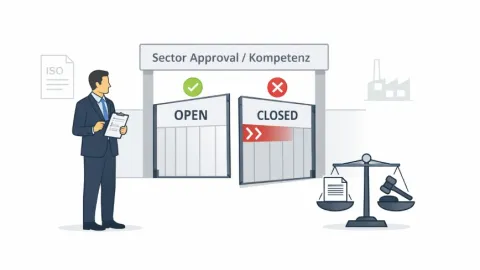
Is DAkkS Applying Auditor Competence Rules Too Strictly?
Certification expert Jörg Roggensack has criticized how the German accreditation body DAkkS interprets competence requirements for management system auditors, warning that the approach could lead some auditors to lose their ability to work in certain sectors.
New Normal In Quality Shifts Focus From Order To Organizational Resilience
Quality is entering a “new normal” where traditional approaches no longer match the complexity of modern organizations.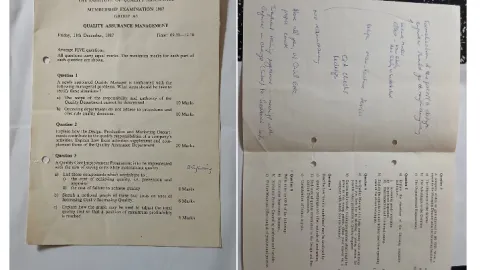
Could Today’s Quality Professionals Pass This 1987 QA Exam?
A decades-old professional exam for quality managers has drawn attention after resurfacing online, raising the question of whether today’s professionals could still answer its questions.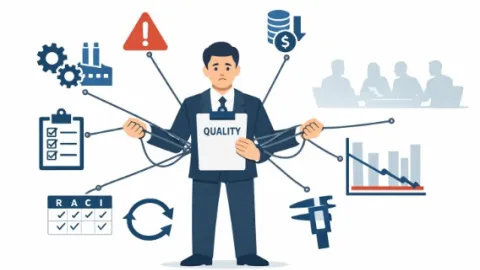
QA Managers Often Leave Their Roles Early But Companies Can Change That
Quality managers are often unhappy in their roles, writes Bruce Hutain, a quality assurance professional with over two decades of experience in such roles.
Rethinking The Future Of Audits: Remote Experts, AI Support And Augmented Reality
As auditors face growing pressure from high workloads and an aging workforce, Jörg Westphal of Hellmund Personalberater explores new ways of combining experience and technology to support the future of auditing.
90 Day ISO Certification Debate Hinges on Readiness Not Speed
Can a company achieve ISO certification in 90 days?
Seven Decisions That Shape Your Future In Quality
The quality leader you become in five years is shaped by the decisions you make now.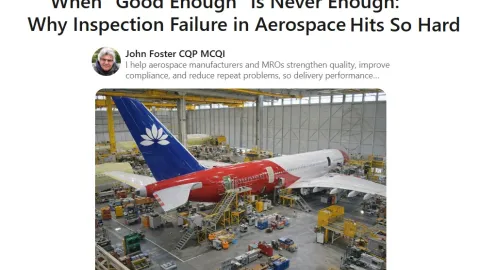
In Aerospace, Severe Consequences Leave No Room For Speed Over Precision
Quality failures in aerospace carry disproportionate consequences, even when they are rare.
Clause 6 On Planning Separates Strategy From Paperwork
Clause 6 on planning in ISO 9001 and IATF 16949 reveals whether a company treats risk as a strategic tool or as a paperwork exercise.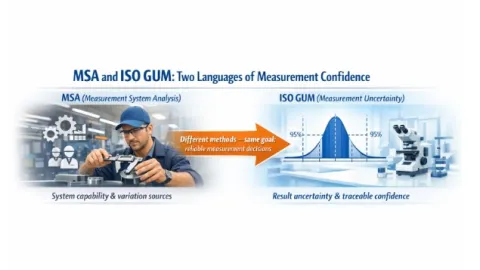
MSA vs ISO GUM: Why One Cannot Replace the Other
MSA (Measurement System Analysis) and the ISO GUM (Guide to the Expression of Uncertainty in Measurement) both deal with measurement variation, but they serve different roles in quality and laboratory decisions.
8 Questions to Ask Before You Adopt an AI Quality Management Tool
Adopting AI in quality management requires a structured, risk-based approach, especially in regulated environments.