Management Systems World
All on Quality and other Standards in one place since 2010. Now Worldwide.
News China
Please note that you have to be a registered member with paid membership in order to see full articles.
RegisterSelected News
China Sets Up Seven Standardization Bodies Including Humanoid Robots Group
The Standardization Administration of China (SAC) has announced the creation of seven new national technical committees and subcommittees, expanding standardization work across sectors from agriculture to advanced technologies.
China Tightens GMP Rules For Medical Device Manufacturers Effective November 2026
The National Medical Products Administration (NMPA) has revised China’s Good Manufacturing Practice (GMP) requirements for medical devices, introducing stricter quality management system rules that will take effect on November 1, 2026 and replace the current 2014 version.
TIC Industry Conference in Beijing Focuses on Trust, Restructuring, and Global Standards Role
The China Quality Certification Center (CQC) hosted the 2026 annual conference on testing, inspection, and certification (TIC) in Beijing on March 26, focusing on strengthening trust, supporting trade, and guiding industry transformation.
China Sets Up Three Regional AI Standardization Groups With Distinct Roles
The Standardization Administration of China (SAC) has established three regional working groups for artificial intelligence, each with a defined focus ranging from international standards work to industrial application.
China Organizes National Push For Codex Agricultural Proposals
China has launched a national call for proposals to support its participation in Codex Alimentarius Commission (CAC) work in the agricultural sector,
China Clarifies Registration Rules for Special Medical Foods Under New Standards
The State Administration for Market Regulation (SAMR) has issued a Q&A to explain how foods for special medical purposes (FSMP) should be registered under China’s updated national standards, helping companies understand how to apply the new rules in practice.
CNAS Warns Against Misuse Of Accreditation Mark
The China National Accreditation Service for Conformity Assessment (CNAS) has issued a public statement warning against the misuse of its accreditation mark, identifying a specific case and calling for immediate corrective action.
China Seeks Organizations To Host ISO Compliance And Starch Subcommittees And Build Mirror Bodies
The Standard Innovation Department of the State Administration for Market Regulation (SAMR) has launched a call for organizations to apply to host two ISO subcommittees and to take part in several newly established technical bodies.
China Approves Counterpart Units and Secretariat Hosts for Seven ISO and IEC Technical Bodies
The Standardization Administration of China (SAC) has approved domestic technical counterpart units for seven technical committees within
Shanghai Fumanjia Convenience Earns Grade A Under BRCGS Agents And Brokers Standard
Shanghai Fumanjia Convenience (SFC) has achieved Grade A certification under the BRCGS Global Standard for Agents and Brokers after successfully passing an audit conducted by SGS, an international testing, inspection, and certification body.
CNAS Revises Five Biobank Accreditation Documents And Sets Implementation Plan
China National Accreditation Service for Conformity Assessment (CNAS) has released five revised documents for biobank quality and competence accreditation.
China Seeks Organizations For Avionics, Antenna Measurement And Digital Product Passport Standards Committees
China’s Standards Innovation Department of the State Administration for Market Regulation (SAMR) is seeking an organization to host the secretariat ofGlobal News

GFSI Seeks Feedback on Freshcare and SQF Programs Under 2024 Requirements
The Global Food Safety Initiative (GFSI) has opened public consultations on Freshcare Food Safety & Quality Standard Edition 5 (2026) and SQF Code Edition 10 for recognition against the GFSI Benchmarking Requirements Version 2024.
ISO 20001:2026 Published as First Food Loss and Waste Management Standard
The International Organization for Standardization (ISO) has published ISO 20001:2026, its first management system standard dedicated to preventing and reducing food loss and waste across the food supply chain.
ISO 14060 Net-Zero Draft Fails to Secure Approval, Returns for Revision
The draft of ISO 14060, the proposed international standard for net-zero aligned organizations, has failed to secure the approval needed to advance.
Global ACI Aligns CORSIA MRA Sub-Scope With Fourth Edition of ICAO Manual
Global Accreditation Cooperation Incorporated (Global ACI) has updated the Carbon Offsetting and Reduction Scheme for International Aviation (CORSIA) sub-scope of its Multilateral Recognition Arrangement (MRA) to align it with the latest international guidance.
ISO/UNDP 53001 Debuts as First International Management System Standard for Sustainable Development Goals
ISO and UNDP released ISO/UNDP 53001 on September 28, 2026, the world's first International Standard for managing contributions to the United Nations Sustainable Development Goals (SDGs).
ISO Central Secretariat Explains Key Changes in ISO 9001:2026 in New Video
The International Organization for Standardization (ISO) has released a detailed video explaining the changes in ISO 9001:2026 directly from its Central Secretariat.
Journalism Trust Initiative Proposed as New ISO Workshop Agreement
A proposal has been submitted to develop the Journalism Trust Initiative (JTI) into a new ISO International Workshop Agreement (IWA), extending an existing European framework for trustworthy journalism to the international level.
Global ACI Sets Three-Year Transition Timelines for ISO 14001:2026 and ISO 9001:2026
Global Accreditation Cooperation Incorporated (Global ACI) has set three-year transition periods for accredited certification to ISO 9001:2026 and ISO 14001:2026 , ending September 30, 2029 and April 30, 2029, respectively.
China Approves World’s First Medical Device Standard for AI Brain-Computer Interfaces
China has approved YY/T 2029-2026, the world’s first medical device standard for brain-computer interfaces (BCIs) that use artificial intelligence (AI).
IFS Makes EU Packaging Rules Self-Assessment Tool Available After 70-Company Pilot
International Featured Standards (IFS) has made its self-assessment tool for the EU Packaging and Packaging Waste Regulation (PPWR) available in the IFS Database after a pilot involving 70 companies.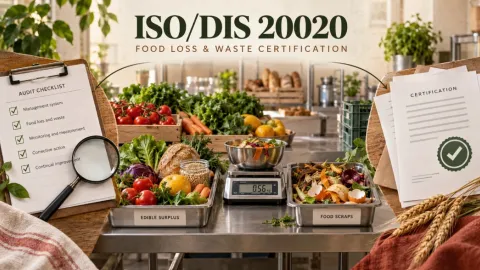
Comment Open on ISO/DIS 20020 for Bodies Auditing and Certifying Food Loss and Waste Management Systems
Comments are open on ISO/DIS 20020, a draft standard setting requirements for bodies that audit and certify food loss and waste management systems (FLWMS).