Management Systems World
All on Quality and other Standards in one place since 2010. Now Worldwide.
News Ecology / Energy / Chemistry
Please note that you have to be a registered member with paid membership in order to see full articles.
RegisterSelected News
Dutch Experts Sought for New European Circular Construction Standards
The European standards committee CEN/TC 350/SC 1 has established five new working groups to develop standards for circular design, material efficiency, and reuse in the construction sector.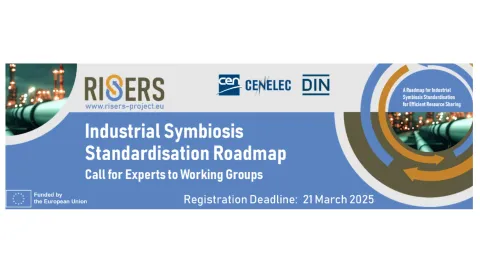
CEN and CENELEC Seek Experts for Industrial Symbiosis Working Groups
CEN and CENELEC, in partnership with DIN, are inviting experts to join Working Groups (WGs) for the development of the Industrial Symbiosis (IS) Standardization Roadmap under the Horizon Europe RISERS project.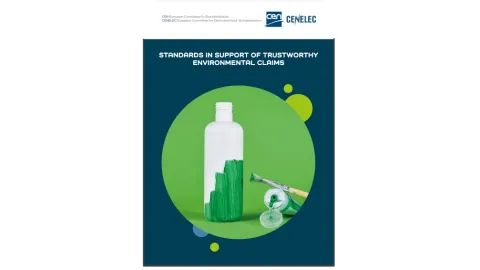
CEN and CENELEC Release Brochure on Trusted Standards to Prevent Greenwashing in Environmental Claims
Consumers often struggle to interpret sustainability labels, making it difficult to differentiate genuine environmental efforts from marketing claims.
Dutch Energy Sector Pushes for Circular Infrastructure as NEN Supports Transition
The Dutch energy sector is taking significant steps toward a circular economy to reduce the use of raw materials like aluminum, copper, and steel.
Inmetro Offers Exclusive License for Nanocarbon Technology to Drive Decarbonization
The National Institute of Metrology, Quality and Technology (Inmetro) and the Federal University of Rio de Janeiro (UFRJ) have announced an exclusive licensing opportunity for a new technology that converts lignin, a common waste product in paper and biofuel production, into nanocarbon.
Upcoming Guidance to Pave the Way for Emission-Free Construction Sites in Denmark
A new guidance, DS/INF, is being developed to promote emission-free construction sites in Denmark, creating a shared understanding and framework for the industry.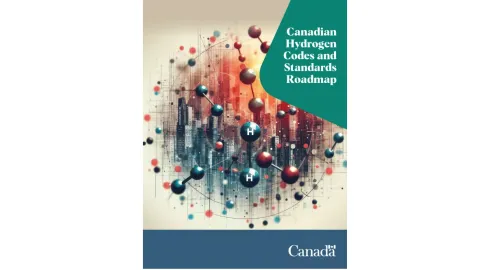
Hydrogen Codes and Standards Roadmap Positions Canada for Clean Energy Growth
The Standards Council of Canada (SCC) has published the Canadian Hydrogen Codes and Standards Roadmap to support the deployment of hydrogen technologies.
BSI Updates PAS 402 to Improve Waste Management and Boost Circular Economy
The British Standards Institution (BSI) has revised its waste resource management specification, PAS 402:2025, to help businesses enhance recycling quality, reduce compliance costs, and simplify data reporting.
Public Consultation Opens for European Standard on Factory Sustainability
A draft European standard for assessing factory sustainability is now open for public consultation until March 10.
Canada’s Communities Integrating Natural Assets into Financial Reporting with New Guide
A new guide titled Getting Nature into Financial Reporting has been released to help Canadian local governments include natural assets - such as wetlands, rivers, forests, and coastal dunes - in their financial reports.
China Releases New Standard for Assessing Greenhouse Gas Emission Reductions
China has introduced GB/T 44915-2024, a national standard for assessing greenhouse gas emission reductions in waste gas, wastewater treatment, and waste residue recovery.
BNQ Unveils New Certification for Recycled Plastic Products
The Bureau de normalisation du Québec (BNQ) now offers certification for companies in the plastics sector under the Canadian standard CAN/BNQ 3840-100.Global News
TIC Council Sets Principles For Digitalization Of Assurance Services
TIC Council, the global trade association representing the independent third-party testing, inspection and certification sector,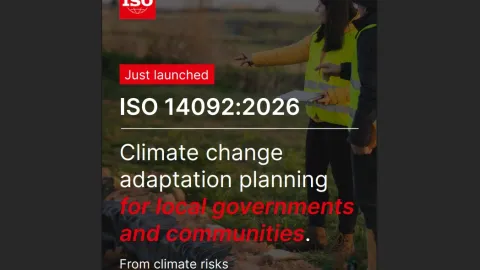
ISO Launches ISO 14092 Climate Adaptation Planning Standard For Local Governments And Communities
The International Organization for Standardization (ISO) has published ISO 14092:2026, a new International Standard that sets clear requirements and guidance for climate change adaptation planning by local governments and communities.
ISO 9002 Revision: Second Working Draft Completed
The International Organization for Standardization (ISO) has completed the second Working Draft of its ISO 9002 revision, marking further progress in updating the guidance to reflect changes in ISO 9001.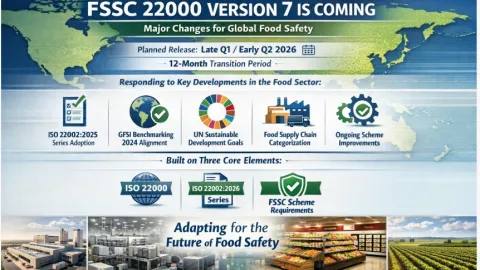
FSSC 22000 Version 7 Nears Release with Major Food Safety Updates
FSSC 22000, a global food safety certification scheme developed by the Foundation FSSC, is moving toward Version 7, a major update that will reshape how food businesses manage safety, align with new global requirements, and prepare for future industry demands.
ISO 45001 Second Committee Draft Version Highlights Safety Culture and Workplace Wellbeing
The revision of ISO 45001 has advanced with the publication of the second version of the first Committee Draft, maintaining the standard at the Committee Draft stage and reflecting feedback from the first international enquiry.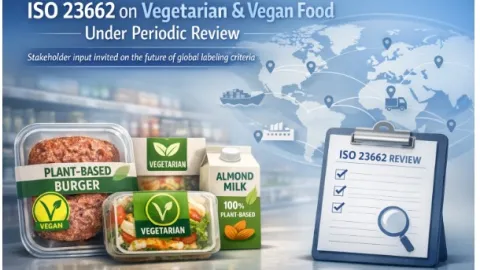
ISO 23662 on Vegetarian and Vegan Foods Enters Periodic Review
ISO 23662:2021, the international standard that defines criteria for vegetarian and vegan foods, has entered its periodic review phase, giving stakeholders the opportunity to decide whether it should remain unchanged or be revised.
PEFC Circular Materials Task Force Established, Experts and Stakeholders Invited to Apply
The Programme for the Endorsement of Forest Certification (PEFC) has established its PEFC Circular Materials Task Force and is inviting nominations for membership by March 18, 2026.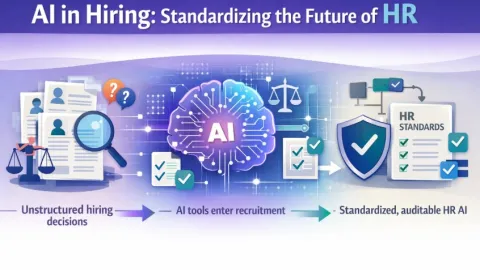
ASTM Develops WK91420 Guide for Artificial Intelligence in HR
ASTM International is developing a new guide, WK91420, to set clearer standards for artificial intelligence (AI) in recruitment and hiring, aimed at reducing bias and improving fairness.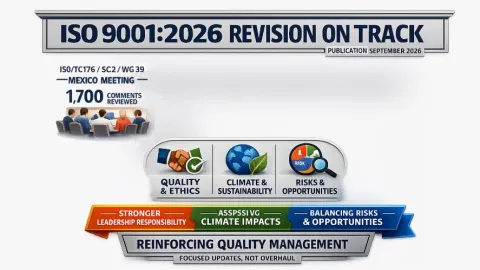
ISO 9001 Revision Advances After Review of 1,700 DIS Comments
The revision of ISO 9001 has moved into a decisive stage, with international experts completing the review of comments on the Draft International Standard (DIS) and confirming that the new edition is on track for publication in September 2026.
ISO Launches ISO 14019 Series With New Standards Supporting Validation and Verification of Sustainability Information
The International Organization for Standardization (ISO) has published the first three standards launching the ISO 14019 series,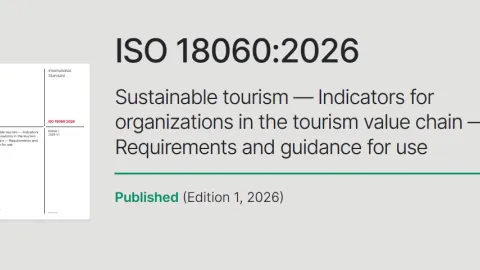
ISO 18060 Sets Global Rules to Measure Tourism Environmental and Social Impact
ISO 18060, a newly published international standard from January 2026, sets out a global framework to help tourism organizations measure their environmental, social, human, and economic impacts in a consistent and comparable way.