
Management Systems World
All on Quality and other Standards in one place since 2010. Now Worldwide.
News Asia
Please note that you have to be a registered member with paid membership in order to see full articles.
RegisterSelected News

China Releases Standard for Zero Carbon Restaurant Construction and Operation
A new voluntary group standard for zero carbon restaurants has been officially released in China, providing technical requirements for their construction and operation.
PT Adi Askara Bumi Earns Management System Certification Body Accreditation
PT Adi Askara Bumi, the internal certification body of the Pertamina Group, Indonesia’s state-owned energy company, has been accredited as a Man. Sys. Certification Body by the National Accreditation Committee (KAN).
BIS Invites Indian Experts to Shape ISO Environmental Standards Review
The International Organization for Standardization (ISO) has launched the systematic review of 12 environmental standards, and the Bureau of Indian Standards (BIS) is inviting Indian experts to help shape the country’s position in this international process.
Indian Government Extends Quality Certification Fee Concessions For Small Firms By Three Years
India’s government will extend fee concessions for quality certification by three years to support small and medium enterprises and strengthen its manufacturing base.
China Launches Global AI Standards Library And Terminology Database
China has officially introduced a global artificial intelligence standards library and a global AI terminology database, consolidating key standards and definitions to support the development and coordination of AI standardization work.
Thailand Establishes National Halal Food Standard Across Entire Food Chain
Thailand has formally established a national Halal food standard that applies to the entire food chain, from raw material acceptance to food service.
Bangladesh Accreditation Board Joins IAF as Accreditation Body Member
The International Accreditation Forum (IAF) has announced that the Bangladesh Accreditation Board (BAB) has joined as an Accreditation Body Member.
China Revises Forest Certification Body Accreditation Scheme Under CNAS-SC23:2026
The China National Accreditation Service for Conformity Assessment has issued a revised forest certification body accreditation scheme, formally replacing the 2022 edition with CNAS-SC23:2026.
Axis Bank Becomes First Financial Services Institution to Receive ISO 42001 AI Certification
Axis Bank, one of the largest private sector banks in India, has become the first financial services institution globally to be certified to ISO/IEC 42001 for its Artificial Intelligence Management System (AIMS).
FSSC 22000 Licenses Terminated for SLSI and KMR
The Foundation FSSC has terminated FSSC 22000 license agreements with the Sri Lanka Standards Institution (SLSI) and Korea Management Registrar, Inc., (KMR) under its sanction policy.
Heilongjiang Transportation Receives ISO 37301 Compliance Certification
Heilongjiang Transportation Investment Group Co., Ltd. and its expressway subsidiary, Heilongjiang Province Expressway Group Co., Ltd.,
Korea Sets Out 2026 National Quality Award Briefings for Applicants
The Korean Standards Association (KSA) will hold official briefing sessions to explain how the 2026 National Quality Award government honors will be run,Global News
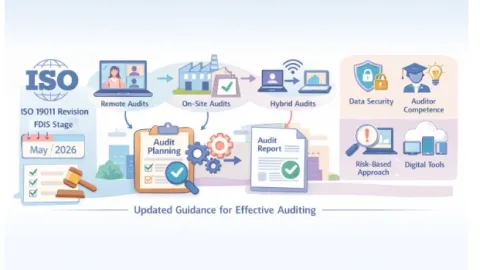
ISO 19011 Auditing Standard Enters Final Stage With Hybrid And Digital Shift
The International Organization for Standardization (ISO) has advanced the revision of ISO 19011 to the Final Draft International Standard (FDIS) stage.
IMDRF Playbook Guides Global Use Of Shared Medical Device Regulatory Reviews
The International Medical Device Regulators Forum (IMDRF) has published a playbook to help regulators use shared approaches when reviewing medical devices, known as regulatory reliance.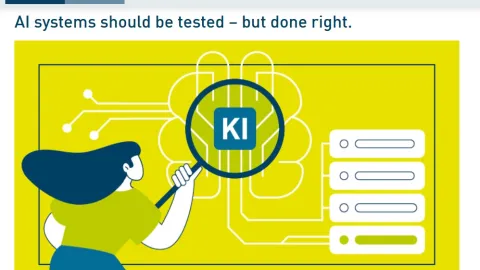
DIN Introduces First Framework For AI Testing Tools
The German Institute for Standardization (DIN) has published DIN SPEC 92006, introducing the first unified framework for artificial intelligence (AI) testing tools and setting clear requirements for how these tools should be designed and used.
FSSC 22000 Version 7 Release Moved To May 2026
The Foundation for Food Safety Certification (FSSC) has delayed the launch of FSSC 22000 Version 7, with publication now expected in early May 2026.
FSC Launches Normative Newsfeed For Clearer Requirements Updates
The Forest Stewardship Council (FSC) has introduced a new Normative Newsfeed to make updates to its requirements easier to track and understand.
OECD Report Links Standards To More Effective Regulation
The Organisation for Economic Co-operation and Development (OECD) has released a report examining how governments can improve regulation by making better use of standards, measurement, and assurance systems, known as quality infrastructure (QI).
ISO 9000 Revision Reaches Final Draft Stage, Publication Expected In May 2026
The revision of ISO 9000, the international standard that defines the basic concepts and vocabulary of quality management, has reached the Final Draft International Standard (FDIS) stage, the final step before publication.
ISO and IEC Form JTC 5 Committee on Digital Product Passport Standards
A new international standards committee has been created to develop standards for digital product passports (DPPs), systems designed to share key product information across the entire lifecycle and improve transparency and circular economy practices.
Third Edition of ISO 22301 Business Continuity Standard Enters Development
The next revision of ISO 22301, the international standard for business continuity management systems (BCMS), has moved into development.
Global Accreditation Cooperation Incorporated Launches Website
Global Accreditation Cooperation Incorporated has launched its new official website, providing a central online platform for the organization that became the single global body for international accreditation cooperation.
Cradle to Cradle Certified Version 5 Released With Stronger Focus On Measurable Product Requirements
The Cradle to Cradle Products Innovation Institute (C2CPII) has released Version 5 of the Cradle to Cradle Certified standard,
