Management Systems World
All on Quality and other Standards in one place since 2010. Now Worldwide.
News European Union
Please note that you have to be a registered member with paid membership in order to see full articles.
RegisterSelected News
Dutch Accreditation Council Updates ISO/IEC 17020 Transition Document and Publishes ISO/IEC 17024 Plan
The Dutch Accreditation Council (RvA) has updated its existing ASR013 transition specification for EN ISO/IEC 17020:2026 and published a new ASR014 transition specification for EN ISO/IEC 17024:2026.
SEK Enhances KravSmart Digital Standards Platform
Swedish Electrotechnical Standardization Organization (SEK) has updated its KravSmart digital standards platform with a new lifecycle view, improved search results and easier navigation.
Poland Adjusts Accreditation Rules for Transition to New EU Construction Products Regulation
The Polish Centre for Accreditation (PCA) has opened consultation on revised DAN-01 accreditation rules as the construction products sector transitions from the existing EU Construction Products Regulation (CPR), Regulation (EU) No 305/2011, to the new CPR, Regulation (EU) 2024/3110.
Bureau Veritas Iberia Becomes First ENAC-Accredited ISO 37301 Certification Body
Bureau Veritas Iberia has become the first certification body accredited by the Spanish National Accreditation Body (ENAC) to certify compliance management systems under UNE-EN ISO 37301.
Revista UNE Puts New ISO 9001 at Center Stage With Detailed Look at 2026 Changes
The Spanish Association for Standardization (UNE) has published the September 2026 issue of Revista UNE, with ISO 9001:2026 as its main feature and a closer look at the changes organizations will need to understand.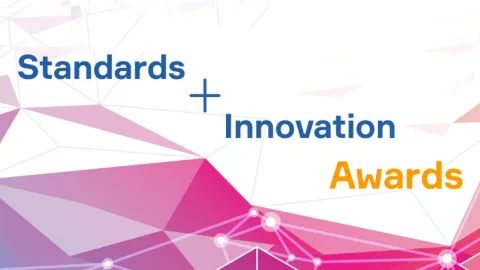
CEN and CENELEC Announce 2026 Standards+Innovation Award Nominees
CEN and CENELEC have published the nominees for the 2026 Standards+Innovation Awards, with 26 submissions received from their members across four categories.
Italy Publishes UNI/PdR 193:2026 for Digital Skills Certification
The Italian Standards Body (UNI) has published UNI/PdR 193:2026, setting common requirements for assessing and certifying digital skills in Italy based on the European DigComp and DigCompEdu frameworks.
CEN and CENELEC Young Professionals Series Returns With Markus Beckman
CEN and CENELEC have started the 2026 edition of their Young Professionals in European Standardization interview series with Swedish sustainability specialist Markus Beckman, whose work focuses on life-cycle assessment and the reuse of construction products.
Seven Updated EN 12896 Standards Published for Public Transport Data Exchange
The European Committee for Standardization (CEN) has published seven updated standards in the EN 12896 series, known as Transmodel, bringing Europe's reference model for public transport data to version 6.2.
Sweden’s First Preparedness Standard SS 22306 Enters Final Stage
The Swedish Standards Institute (SIS) is finalizing SS 22306, Sweden’s first preparedness standard for helping organizations continue operating during wartime or the threat of war.
TÜV AUSTRIA Opens New Branch in Moldova
TÜV AUSTRIA, an independent Austrian testing, inspection and certification provider, has opened a new branch in Chișinău, expanding its services in the Republic of Moldova.
Czech Standards Agency Forms Council to Help Shape AI Testing Framework
The Czech Standards Agency (ČAS) has formed a Market and Innovation Council to involve the private sector in preparing a regulatory sandbox under the European Union’s Artificial Intelligence Act (EU AI Act).Global News
ISO 45010 Becomes First International Standard on Menstruation and Menopause at Work
ISO has published ISO 45010, the first International Standard focused on supporting employees experiencing menstruation and menopause at work.
Digital Identity Standards Now Freely Accessible Worldwide
Key ISO and IEC digital identity standards, including the ISO/IEC 18013 and ISO/IEC 23220 series, are now freely accessible worldwide through a new sponsorship model set up by the German Institute for Standardization (DIN) and the OpenWallet Foundation (OWF).
GFSI Opens Consultation on FSSC 22000 Version 7 Against 2024 Benchmarking Requirements
The Global Food Safety Initiative (GFSI) has opened a public consultation on the recently updated FSSC 22000 Version 7 as part of its assessment against the GFSI Benchmarking Requirements Version 2024.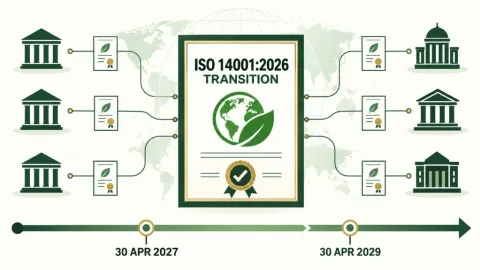
Accreditation Bodies Roll Out ISO 14001 Transition Plans
Accreditation bodies are putting the ISO 14001:2026 transition timetable into practice, with Norwegian Accreditation (NA) among the latest to publish detailed arrangements for certification bodies moving to the revised environmental management systems standard.
ISO Considers Three Tourism Proposals on Restaurant Evaluation, Tourist Guides and AI
Three tourism standardization proposals are now under consideration at the International Organization for Standardization (ISO), covering restaurant evaluation, professional tourist guide services and the use of artificial intelligence with tourism destination data.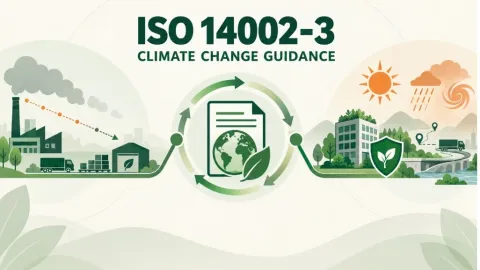
ISO 14002-3 Released as Guidance on Climate Change
The International Organization for Standardization (ISO) has released ISO 14002-3:2026, new guidance to help organizations using ISO 14001 address climate change through their environmental management systems.
AIQI Publishes First AI Use Case for Management System Certification Decisions
The Artificial Intelligence Quality Infrastructure (AIQI) Consortium has published a new use case examining how AI could support management system certification decisions, including the risks, limitations and controls that conformity assessment bodies may need to consider.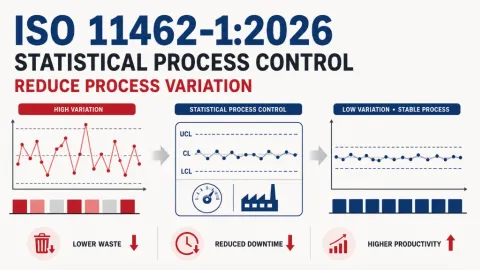
ISO 11462-1:2026 Updates Statistical Process Control to Reduce Process Variation
The International Organization for Standardization (ISO) has published ISO 11462-1:2026, updating guidance on statistical process control (SPC) to help organizations improve the stability and capability of their processes.
Codex Sets New Labelling Rules for Multipacks and Outer Packaging
The Codex Alimentarius Commission (CAC) has adopted new requirements for foods sold in multipacks or grouped together in one outer package, clarifying what information must appear on the packaging consumers see when buying the product.
SBTi Net-Zero Standard Version 2.0 Adds New Rules for Corporate Climate Targets, Reporting and Carbon Removals
The Science Based Targets initiative (SBTi) published Version 2.0 of its Corporate Net-Zero Standard on June 11, introducing new requirements for how companies set climate targets, plan their transition to net zero, report progress and deal with emissions that remain.
CSA Group to Sell Testing and Certification Business to Kiwa
Kiwa and CSA Group have agreed on a deal worth around $1.5 billion for Kiwa to acquire CSA Group’s testing, inspection and certification business, significantly expanding the Dutch company’s presence in North America.