Management Systems World
All on Quality and other Standards in one place since 2010. Now Worldwide.
News Italy
Please note that you have to be a registered member with paid membership in order to see full articles.
RegisterSelected News
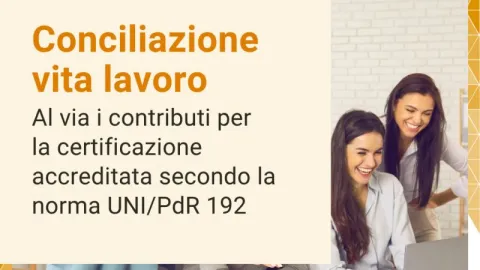
Work–Life Balance Certification Scheme Opens in Italy
Italy has opened a certification scheme for organizations applying UNI/PdR 192:2026, which sets requirements for managing work–life balance and family well-being.
Accredia Annual Report: Over 100,000 Italian Companies Have Certified Management Systems
The Italian Accreditation Body (Accredia) reports in its 2025 Annual Report that the number of companies with accredited certified management systems exceeded 100,000, up from about 75,000 in 2012.
Italy Makes National Organic Brand Available Alongside EU Organic Logo
The Italian Ministry of Agriculture, Food Sovereignty and Forestry (MASAF) has finalized the rules allowing eligible organic products to display the new Italian Organic Brand alongside the European Union organic logo.
Rethinking Cities in the Latest Edition of UNI's STANDARD Magazine
The Italian Standardization Body (UNI) has published the latest edition of STANDARD Magazine, centered on how cities can become more sustainable, resilient and better adapted to future social, environmental and technological challenges.
Digital Process Certification Opens for Italy's Construction and Real Estate Sectors
The Italian Accreditation Body (Accredia) has launched an accredited certification scheme for digital process management systems in the construction and real estate sectors based on the new UNI 11337-8:2026 standard.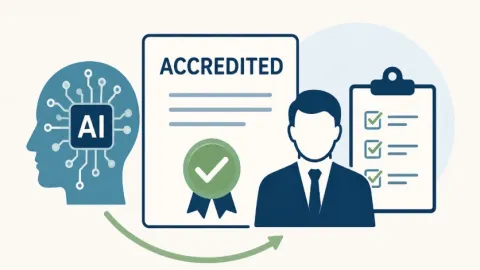
Accredia Opens Accreditation for Certification of AI Professionals
The Italian Accreditation Body (Accredia) has opened accreditation for certification bodies that certify AI professionals under the new UNI 11621-8:2026 standard.
Accredia Letter Spotlights Biobanks, ISO 14001 Transition and Procurement
The Italian Accreditation Body (Accredia) has published the May 2026 issue of Accredia Letter,
Italy Adopts ISO 22367:2026 for Medical Laboratory Risk Management
The Italian National Standardization Body (UNI) has published the Italian adoption of ISO 22367:2026, the revised international guidance standard for risk management in medical laboratories.
Italy Updates Sustainable Aquaculture Rules With Stricter Traceability Requirements
Italy’s Ministry of Agriculture has updated the production specifications for the National Livestock Quality System (SQNZ) “Sustainable Aquaculture” scheme, which sets the certification requirements for participating producers.
Lamborghini Recognized for Environmental, Social and Governance Practices
Automobili Lamborghini has received ESG Recognition from DNV, for using certified management systems to support its environmental, social, and governance commitments.
Accredia Passes EA Peer Evaluation for Biobanking Accreditation
The Italian accreditation body Accredia has passed a peer evaluation by the European co-operation for Accreditation (EA), advancing the process for international recognition of Italian biobank accreditations under ISO 20387.
Italy Opens Consultation on Food Traceability Certification Rules
The Italian National Unification Body (UNI) has opened a public consultation on a new reference practice that would define how accredited certification bodies assess traceability systems in agri-food supply chains under UNI EN ISO 22005:2008.Global News
ISO 9001:2026 Officially Launched
The sixth edition of ISO 9001, the world’s most widely used quality management system standard, has been officially launched by ISO during a virtual press conference.
Global Responsible Textile Standard (GRTS) Launches for Certification of Wider Range of Fibers
Global Standards has launched the Global Responsible Textile Standard (GRTS), a new certification standard for textiles made from a wider range of plant, animal, synthetic, man-made cellulosic and recycled fibers.
ISO 45001 Second Edition Clears DIS Ballot With Overwhelming Support
The draft second edition of ISO 45001 has passed its Draft International Standard (DIS) vote with only one vote against, moving the revision closer to its planned publication in the first half of 2027.
Second Edition of ISO/IEC 17065 Reaches Final Approval Phase
The second edition of ISO/IEC 17065, which sets requirements for bodies that certify products, processes and services, has moved further into the final approval process and is now at stage 50.20 of the Final Draft International Standard (FDIS) phase.
SMART Initiative Enters Pilot Phase in October, Testing Nine Standards
A pilot of the ISO and IEC SMART standards initiative will begin in October, testing nine selected international standards.
New Net Zero Carbon Cities Standard Project Approved as ISO 37115-2
The International Organization for Standardization (ISO) has approved a proposal for ISO 37115-2, a new standard that will set out principles and fundamentals for net zero carbon cities.
First Edition of ISO 41002 Guides Development of Facility Management Organizations
The first edition of ISO 41002 gives organizations guidance on how to develop and structure their facility management function across strategic, tactical and operational levels.
ISO/DTS 5112 Road Vehicle Cybersecurity Audit Guidance Reaches Final Approval Stage
ISO/DTS 5112, the draft Technical Specification for auditing cybersecurity management systems (CSMS) across the automotive supply chain, has reached the final approval stage.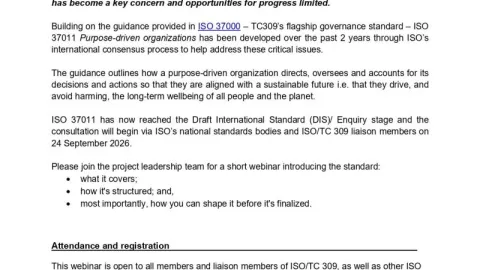
ISO 37011 Webinars on Purpose-Driven Organizations Set for September 22 and 23
Two international webinars on ISO 37011, the draft guidance standard for purpose-driven organizations, will be held on September 22 and 23 ahead of consultation on the draft beginning September 24, 2026.
ISO 45010 Becomes First International Standard on Menstruation and Menopause at Work
ISO has published ISO 45010, the first International Standard focused on supporting employees experiencing menstruation and menopause at work.
Digital Identity Standards Now Freely Accessible Worldwide
Key ISO and IEC digital identity standards, including the ISO/IEC 18013 and ISO/IEC 23220 series, are now freely accessible worldwide through a new sponsorship model set up by the German Institute for Standardization (DIN) and the OpenWallet Foundation (OWF).