Management Systems World
All on Quality and other Standards in one place since 2010. Now Worldwide.
News
Please note that you have to be a registered member with paid membership in order to see full articles.
RegisterSelected News
China Launches 2026 Review of Mandatory National Standards
China has launched its 2026 review of mandatory national standards,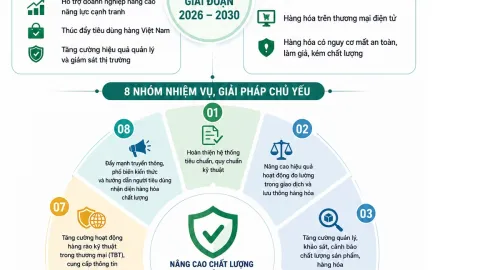
STAMEQ Launches 2026–2030 Plan to Strengthen Domestic Market Through Standards
The Commission for the Standards, Metrology and Quality of Vietnam (STAMEQ) has launched a 2026–2030 plan to improve product quality, protect consumers and strengthen the domestic market.
ISO/IEC 17020:2026 Transition Rules Published for Dutch Accredited Inspection Bodies
The Dutch Accreditation Council (RvA) has published ASR013, the mandatory transition document explaining how accredited inspection bodies must move from ISO/IEC 17020:2012 to ISO/IEC 17020:2026.
DIN Makes ISO 9002 Draft Available for Public Comment in Germany
The German Institute for Standardization (DIN) has made the draft of ISO 9002 available for free reading and public comment in Germany, giving quality professionals an opportunity to help shape guidance for implementing the revised ISO 9001 during the draft stage.
HKAS News Issue 79 Highlights Assessor Forum 2026
The Hong Kong Accreditation Service (HKAS) has published Issue 79 of HKAS News, led by coverage of the 2026 HKAS Assessor Forum and featuring updates on accreditation, assessor training and international cooperation.
ELOT Marks 50 Years of Standardization in Greece
The Hellenic Organization for Standardization (ELOT) marked the 50th anniversary of its establishment with a ceremony celebrating five decades of advancing standardization, quality, and reliability in Greece.
PAS 96 Food Defence Guidance Updated With July Corrigendum
The British Standards Institution (BSI) has republished PAS 96:2026 with Corrigendum No. 1, correcting errors in two sections while continuing to offer the document free of charge.
NEN Publishes Dutch ISO 14001:2026 With Practical Transition Guide
The Netherlands Standardization Institute (NEN) has published the Dutch edition of ISO 14001:2026,
Kookmin University Wins Korea's 2026 Advanced Industry Standardization Competition
A team from Kookmin University has won Korea's 2026 Advanced Industry Standardization Competition after developing a proposed quality evaluation standard for a vehicle-integrated solar energy system for future mobility.
SNAS Updates Policy for National Conformity Assessment Schemes
The Slovak National Accreditation Service (SNAS) has updated Policy PL-18, introducing a new national procedure for evaluating conformity assessment schemes used only within Slovakia in non-regulated areas.
Italy Makes National Organic Brand Available Alongside EU Organic Logo
The Italian Ministry of Agriculture, Food Sovereignty and Forestry (MASAF) has finalized the rules allowing eligible organic products to display the new Italian Organic Brand alongside the European Union organic logo.
IPQ Opens SME Survey for Quality Value Study
The Portuguese Institute for Quality (IPQ), with support from Ernst & Young (EY), has opened a survey inviting small and medium-sized enterprises (SMEs) to take part in a study measuring the economic, social and environmental value of quality in businesses.Global News

PEFC Circular Materials Task Force Established, Experts and Stakeholders Invited to Apply
The Programme for the Endorsement of Forest Certification (PEFC) has established its PEFC Circular Materials Task Force and is inviting nominations for membership by March 18, 2026.
ASTM Develops WK91420 Guide for Artificial Intelligence in HR
ASTM International is developing a new guide, WK91420, to set clearer standards for artificial intelligence (AI) in recruitment and hiring, aimed at reducing bias and improving fairness.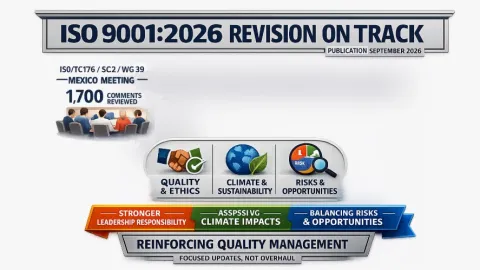
ISO 9001 Revision Advances After Review of 1,700 DIS Comments
The revision of ISO 9001 has moved into a decisive stage, with international experts completing the review of comments on the Draft International Standard (DIS) and confirming that the new edition is on track for publication in September 2026.
ISO Launches ISO 14019 Series With New Standards Supporting Validation and Verification of Sustainability Information
The International Organization for Standardization (ISO) has published the first three standards launching the ISO 14019 series,
ISO 18060 Sets Global Rules to Measure Tourism Environmental and Social Impact
ISO 18060, a newly published international standard from January 2026, sets out a global framework to help tourism organizations measure their environmental, social, human, and economic impacts in a consistent and comparable way.
IFS Introduces Local Check to Support Small-Scale Food Producers
International Featured Standards (IFS) has introduced IFS Local, a new annual standalone food safety check designed to help small-scale and artisanal food producers demonstrate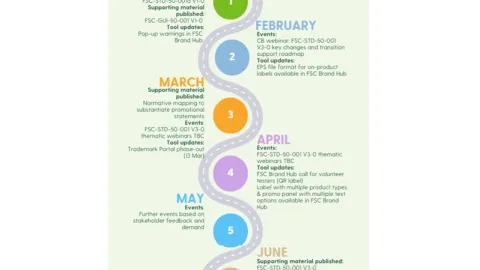
FSC Releases Revised Trademark Standard and Starts Rollout for Certificate Holders
The Forest Stewardship Council (FSC) has released a revised trademark standard and has started rolling out guidance and support materials to help organizations transition to the updated requirements.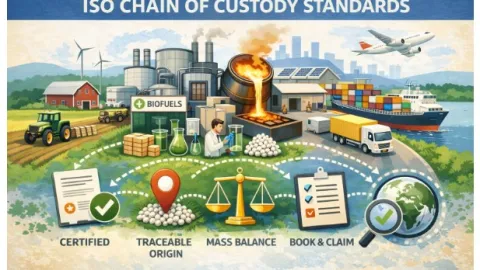
ISO 22095 Parts 2 And 3 Define Rules For Material Tracking Chain Of Custody Models
The International Organization for Standardization (ISO) has published ISO 22095-2 and ISO 22095-3, two new international standards that
CSR Labels and ISO 26000 Linked to Improved Business Performance
A new international study by Responsibility Europe finds that organizations using recognized CSR (corporate social responsibility) labels outperform others economically and organizationally, confirming the growing importance of CSR frameworks and ISO 26000 worldwide.
Work Begins on Two Agrifood Data System Standards
The International Organization for Standardization (ISO) has started work on two new international standards for agrifood data systems through ISO/TC 347, focused on crop data definitions and data exchange in greenhouse production.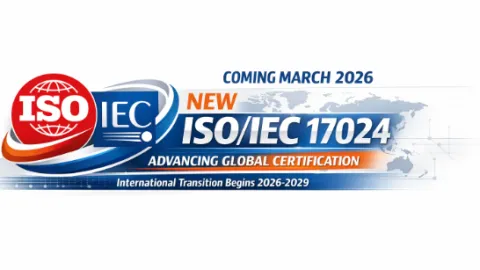
ISO 17024 Enters Final Publication Stage
The revision of ISO/IEC 17024, the international standard that sets requirements for bodies certifying persons, has entered its final publication stage, with release expected in March 2026.