Management Systems World
All on Quality and other Standards in one place since 2010. Now Worldwide.
News
Please note that you have to be a registered member with paid membership in order to see full articles.
RegisterSelected News
Austria Makes Greenwashing Illegal From September 27
Austria will make specified forms of greenwashing, the use of misleading environmental claims in marketing, illegal from September 27, 2026.
Ten QM Software Providers to Present Their Tools at SAQ-QUALICON Event
SAQ-QUALICON is organizing a free online Tool Arena on December 10, 2026, where 10 providers will present their own quality management software.
Peru Adopts ISO 19011:2026 as National Management System Audit Standard
Peru has adopted ISO 19011:2026 as a national standard for management system auditing.
FSC Puts Revised Ukraine Risk Assessment Into Effect With No Transition Period
The Forest Stewardship Council (FSC) has put its revised Risk Assessment for Ukraine into effect from August 14, 2026, with no transition period.
Türkiye Sets Coordinated Transition Timeline for ISO/IEC 27701 and ISO/IEC 27706
The Turkish Accreditation Agency (TÜRKAK) has outlined how accredited certification bodies and their clients must transition to the updated standards for privacy information management certification.
FSSC 22000 V7 Transition Applications Due by Year-End in South Korea
The Korea Accreditation Board (KAB) has set a December 31, 2026 deadline for existing KAB-accredited FSSC 22000 certification bodies to submit their applications to transition accreditation from Version 6 to Version 7.
Sweden Sets Transition to Revised Inspection Body Accreditation Standard
Swedish Board for Accreditation and Conformity Assessment (Swedac) has set its transition plan for ISO/IEC 17020:2026,the revised international standard for inspection bodies. New accreditation applications must use the 2026 edition from October 1, 2026, while the 2012 edition will cease to apply in March 2029.
Taiwan Sets October 1 Start for ISO/IEC 17020:2026 Accreditation Applications
The Taiwan Accreditation Foundation (TAF) will begin accepting accreditation applications under ISO/IEC 17020:2026 on October 1, 2026, as it starts the formal transition from the 2012 edition of the standard.
China Quality Certification Centre Awards AAAA Medical Data Quality Certificate to Jiangsu Cancer Hospital
The China Quality Certification Centre (CQC) has awarded an AAAA medical data quality evaluation certificate to Jiangsu Cancer Hospital for a dataset covering anesthesia and pain management around cancer surgery.
NIST Seeks Comments on Customizable AI Evaluation Framework
The National Institute of Standards and Technology (NIST) has released an initial draft of NIST AI 200-2, The TEVV-Athlon Framework for Evaluating AI Systems, and is seeking comments through October 6, 2026.
March 2029 Deadline Set for ISO/IEC 17020:2026 Transition in Denmark
The Danish Accreditation Fund (DANAK) has set a March 31, 2029 deadline for inspection bodies to complete the transition to ISO/IEC 17020:2026.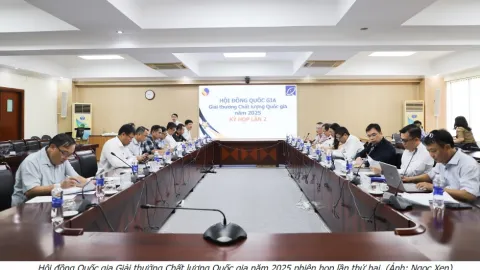
25 Organizations Recommended for Vietnam’s 2025 National Quality Awards
Vietnam’s National Council for the National Quality Award has recommended 25 organizations and businesses for the 2025 awards, including 17 candidates for the Gold Award.Global News
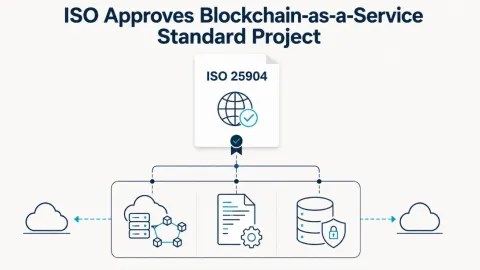
ISO Approves Blockchain-as-a-Service Standard Project
The International Organization for Standardization (ISO) has approved ISO 25904, a new standard project to establish a common technical framework and functional requirements for Blockchain-as-a-Service (BaaS) platforms.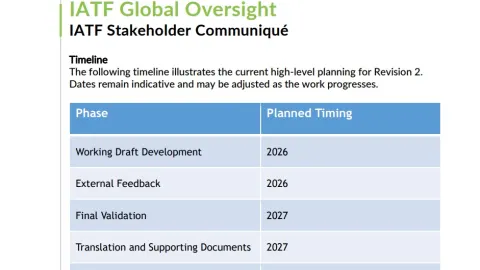
IATF 16949 Second Edition Expected in Mid-2027 With Five Priorities Set
IATF 16949 is expected to reach its second edition in mid-2027, with five priorities set for the revision.
GHG Protocol Aligns Scope 2 and AMI Development for Future Joint ISO Standard
The Greenhouse Gas Protocol (GHG Protocol) the results of its public consultation on the update to its Scope 2 Guidance and released preliminary feedback on the development of its Actions and Market Instruments (AMI) standard.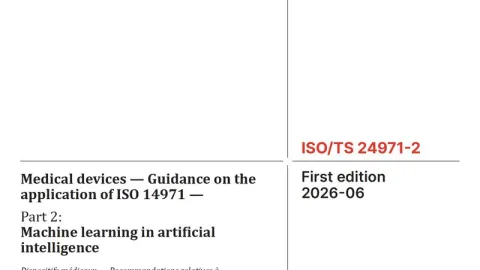
Risk Management Guidance for AI-Powered Medical Devices: First Edition of ISO/TS 24971-2 Released
ISO has released the first edition of ISO/TS 24971-2:2026, providing guidance on applying the ISO 14971 risk management process to machine learning-enabled medical devices (MLMDs).
Revised ISO 19008 Expands Cost Coding System to Lower Carbon Energy
ISO 19008 has been revised to extend its common system for organizing and comparing cost data to lower carbon energy as well as oil and gas.
GLOBALG.A.P. Farm Assurance and Social Practice Standards Set for September Update
Agraya has announced that it will publish GLOBALG.A.P. Integrated Farm Assurance (IFA) v6.1 Smart and GLOBALG.A.P. Risk Assessment on Social Practice (GRASP) v2.1 on September 1, 2026.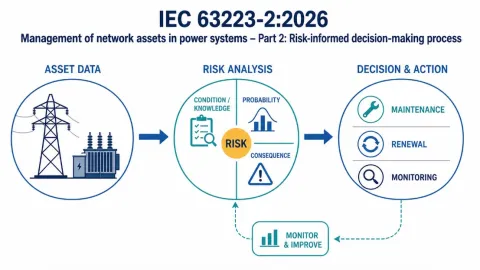
IEC 63223-2 Sets Risk-Informed Decision-Making (RIDM) Process for Power Network Assets
The International Electrotechnical Commission (IEC) has published IEC 63223-2:2026, introducing a structured risk-informed decision-making (RIDM) process for managing existing assets in power networks.
VDA Releases ISA 2027 Information Security Assessment Catalogue for TISAX
The German Association of the Automotive Industry (VDA) has published ISA 2027, the next version of the Information Security Assessment (ISA) catalogue used by TISAX, an information security assessment and exchange mechanism for the automotive industry.
Global Standards Updates Flagship GOTS Standard to Version 8.1
The Global Standards (GS) has updated the Global Organic Textile Standard (GOTS) to Version 8.1, its first revision since the major Version 8.0 release in March.
TÜV SÜD Acquires SustainCERT to Accelerate Digital Carbon Verification
Germany-based testing, inspection and certification company TÜV SÜD has acquired climate verification platform SustainCERT
ISO 30201 Adds Human Resources to the ISO Management System Family
The International Organization for Standardization (ISO) has published ISO 30201:2026, the first international requirements standard for human resources management systems.