Management Systems World
All on Quality and other Standards in one place since 2010. Now Worldwide.
News Europe
Please note that you have to be a registered member with paid membership in order to see full articles.
RegisterSelected News

Serbia Opens Public Consultation on AI Quality Management Standard EN 18286
The Institute for Standardization of Serbia (ISS) has launched a public consultation on draft standard naSRPS EN 18286:2025,
Serbian Pharma Conference Explores Digital Transformation of GxP Activities
The Chamber of Commerce and Industry of Serbia (PKS) hosted a professional conference on October 30 focusing on the digitalization of GxP (Good Practice) activities across the supply chain for human medicines.
Croatia Adopts New Rules for Authorizing Two Types of Food and Feed Control Laboratories
The Ministry of Agriculture of Croatia has adopted a new regulation,
External Evaluation Results for All Croatian Higher Education Institutions Released
The Agency for Science and Higher Education (AZVO) has released the results of external evaluations for all higher education institutions and scientific institutes operating within the Croatian higher education system.
ISS Publishes Monograph Marking 90 Years of Standardization in Serbia
The Institute for Standardization of Serbia (ISS) has published a monograph celebrating nine decades of standardization in the country,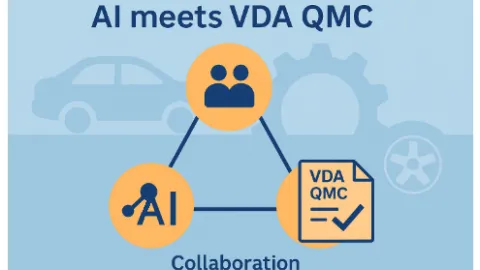
VDA QMC Project Group Presents AI Framework for Quality Management
The Quality Management Center of the German Association of the Automotive Industry (VDA QMC) is developing a new VDA Volume on the use of artificial intelligence in quality management.
Standardizing Hospital Design Terminology with New UNI 11993
Italy’s national standards body UNI has published UNI 11993, a new standard that defines terminology for hospital and healthcare structures to
France Expands Sustainable Food Label to Restaurants and Caterers
France has expanded its national anti-food waste label from the food distribution sector to include restaurants and catering services.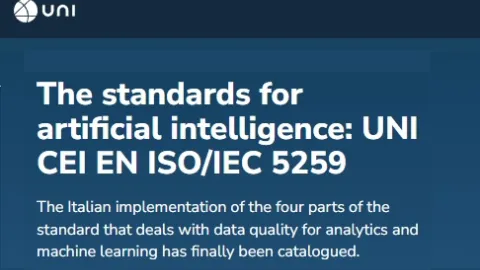
Italy Publishes Four Parts of National Adaptation of ISO/IEC 5259 AI Data Quality Standards
The Italian Organization for Standardization (UNI) has issued the national adaptation of ISO/IEC 5259, a four-part series focused on data quality for analytics and machine learning.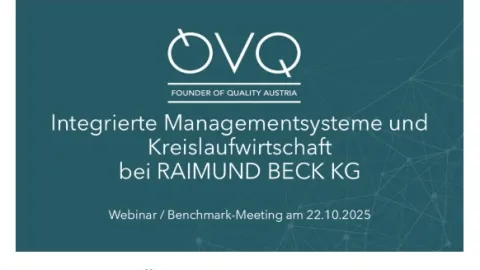
Circular Economy Solutions by Raimund Beck Presented in Austria’s Benchmark Meeting
The Austrian Society for Quality (ÖVQ) held an online benchmark meeting, organized as a webinar, in cooperation with Quality Austria.
Swedac Showcases Digital Transformation at Kvalitetsmässan Quality Fair 2025
The Swedish Board for Accreditation and Conformity Assessment (Swedac) will participate in Kvalitetsmässan (Quality Fair) 2025,
UNE Meeting Explores Key Updates to ISO/DIS 9001 Quality Management Standard
The Spanish Association for Standardization (UNE) held an event on October 3 to review the draft version of the revised ISO 9001, focusing on the most relevant changes in the upcoming update of the quality management systems standard.Global News

GFSI Issues Call for Expert Auditors to Join Phase 2 of Development Effort
The Global Food Safety Initiative (GFSI) has issued an extended call for highly experienced auditors to join the second phase of its Auditor Training and Professional Development (ATPD) governance initiative.
JETI Publishes Key Reports on Metaverse and Intelligent Computing
JETI, the dedicated ISO/IEC advisory group specialized in emerging technologies, has released two reports, focusing respectively on the Metaverse and Intelligent Computing.
As EU Faces US Tariff Risks, Quality Infrastructure Strengthens Economic Integration
An analysis by the Accredia Observatory highlights the risk of new US tariffs on European imports and emphasizes the crucial role of Quality Infrastructure (QI) in safeguarding Europe's integrated economy.
ISO Approves Plan to Develop 56012 Innovation Ecosystem Management Standard
ISO has approved a New Work Item Proposal (NWIP) to develop ISO 56012, a guidance standard on innovation ecosystem management.
Germany Declines to Join New Global Accreditation Organization GLOBAC
On February 26, 2025, the German Accreditation Advisory Board advised the Federal Government that Germany, through its national accreditation body (DAkkS), should not join the newly established Global Accreditation Cooperation (GLOBAC).
BRCGS Releases Module 11 to Align Packaging Standards with tms/HAVI Requirements
BRCGS has introduced Module 11 for its Packaging Materials Issue 7 Standard, developed in partnership with tms/HAVI.
Launch of Global Standards Consultation on PNT (Positioning, Navigation, and Timing)
The International Organization for Standardization (ISO) is inviting experts worldwide to participate in an open consultation on Positioning, Navigation, and Timing (PNT) services.
First Global Standard for Child-Friendly Services for Victims of Violence Released by ISO
In a historic move, the International Organization for Standardization (ISO) has introduced WA 49:2025, the first international guidelines for child-friendly services aimed at supporting victims of violence.
ISO Develops Two Standards for eDNA Analysis in Aquatic Life Research
ISO is developing two international standards to improve the reliability of environmental DNA (eDNA) techniques used to study aquatic life and assess water quality.
Renault Group Updates Quality Requirements for IATF 16949
Renault Group has updated its Customer-Specific Requirements (CSRs) for IATF 16949:2016, effective March 14, 2025.
BRCGS Invites Experts to Join Technical Working Group for Consumer Products Issue 5
BRCGS is calling for industry professionals to join its Technical Working Group (TWG) to help revise the Consumer Products Standard, currently at Issue 4, which was launched in 2016.