Management Systems World
All on Quality and other Standards in one place since 2010. Now Worldwide.
News Laboratory
Please note that you have to be a registered member with paid membership in order to see full articles.
RegisterSelected News

Hong Ngoc Hospital Gene Center Accredited to ISO 15189 for Medical Labs
The National Accreditation Bureau (BoA) has accredited the Gene Center at Hong Ngoc General Hospital - Phuc Truong Minh under ISO 15189,
DAkkS Completes ISO 15189 Transition With All Medical Labs in Germany Retaining Accreditation
The Deutsche Akkreditierungsstelle (DAkkS), Germany’s national accreditation body, has successfully completed the nationwide changeover to the revised DIN EN ISO 15189 standard for medical laboratories.
Cofrac Updates Accreditation Guides for Pathology and Reproductive Biology Labs
The French Accreditation Committee (Cofrac) has released revised versions of two technical accreditation guides, SH GTA 03 and SH GTA 05, aligning them with the 2022 edition of the standard NF EN ISO 15189, the French version of the standard for quality and competence in medical laboratories.
TBDS Digital Verification Now Mandatory for TÜRKAK Calibration Certificates
The Turkish Accreditation Agency (TÜRKAK) is moving ahead with the mandatory implementation of its Document Verification System (TBDS) for calibration laboratories.
German Institutes Publish Tools to Help Smaller Labs Adopt Digital Calibration Certificates
Germany’s National Metrology Institute (PTB) and German Calibration Service (DKD) are helping smaller calibration laboratories move to Digital Calibration Certificates (DCC).
Indonesia Accredits First Lab to Test Police Weapons, Armor and Radios
The Research and Development Center Laboratory of the Indonesian National Police (Puslitbang POLRI) has become the first lab in the country accredited by the National Accreditation Body of Indonesia (KAN) for testing police equipment.
Cofrac Unveils Major Shake-Up of Laboratory Units in 100th Edition of Compétences
The French Accreditation Committee (Cofrac) has announced a significant restructuring of its Laboratory section, featured in the 100th issue of its magazine Compétences.
CQC South China Lab Gains IECEx Approval for Explosion Protection Testing
The China Quality Certification Center (CQC) South China Laboratory has passed the on-site assessment to become an officially recognized IECEx Testing Laboratory (ExTL),
INTI Laboratories Certified by International Olive Council for Olive Oil Quality Testing
The National Institute of Industrial Technology (INTI) has been certified by the International Olive Council (IOC) for its competence in physicochemical analysis of olive oil.
Italy Establishes National Reference Laboratory for Food Improvers
The Italian Ministry of Health has launched the National Reference Laboratory for Food Improvers (LNR-FIA) to enhance food safety regarding additives, enzymes, and flavorings.
CROLAB Invites Laboratories to Participate in Wheat Toxin Testing
CROLAB's Food Section (SEH) is organizing an interlaboratory test to measure deoxynivalenol (DON) levels in wheat samples.
SCC and A2LA Launch First Dual Accreditation Program for North America
The Standards Council of Canada (SCC) and the American Association for Laboratory Accreditation (A2LA) have introduced a dual accreditation program to help testing and calibration laboratories achieve seamless cross-border compliance.Global News
GFSI Seeks Feedback on Freshcare and SQF Programs Under 2024 Requirements
The Global Food Safety Initiative (GFSI) has opened public consultations on Freshcare Food Safety & Quality Standard Edition 5 (2026) and SQF Code Edition 10 for recognition against the GFSI Benchmarking Requirements Version 2024.
ISO 20001:2026 Published as First Food Loss and Waste Management Standard
The International Organization for Standardization (ISO) has published ISO 20001:2026, its first management system standard dedicated to preventing and reducing food loss and waste across the food supply chain.
ISO 14060 Net-Zero Draft Fails to Secure Approval, Returns for Revision
The draft of ISO 14060, the proposed international standard for net-zero aligned organizations, has failed to secure the approval needed to advance.
Global ACI Aligns CORSIA MRA Sub-Scope With Fourth Edition of ICAO Manual
Global Accreditation Cooperation Incorporated (Global ACI) has updated the Carbon Offsetting and Reduction Scheme for International Aviation (CORSIA) sub-scope of its Multilateral Recognition Arrangement (MRA) to align it with the latest international guidance.
ISO/UNDP 53001 Debuts as First International Management System Standard for Sustainable Development Goals
ISO and UNDP released ISO/UNDP 53001 on September 28, 2026, the world's first International Standard for managing contributions to the United Nations Sustainable Development Goals (SDGs).
ISO Central Secretariat Explains Key Changes in ISO 9001:2026 in New Video
The International Organization for Standardization (ISO) has released a detailed video explaining the changes in ISO 9001:2026 directly from its Central Secretariat.
Journalism Trust Initiative Proposed as New ISO Workshop Agreement
A proposal has been submitted to develop the Journalism Trust Initiative (JTI) into a new ISO International Workshop Agreement (IWA), extending an existing European framework for trustworthy journalism to the international level.
Global ACI Sets Three-Year Transition Timelines for ISO 14001:2026 and ISO 9001:2026
Global Accreditation Cooperation Incorporated (Global ACI) has set three-year transition periods for accredited certification to ISO 9001:2026 and ISO 14001:2026 , ending September 30, 2029 and April 30, 2029, respectively.
China Approves World’s First Medical Device Standard for AI Brain-Computer Interfaces
China has approved YY/T 2029-2026, the world’s first medical device standard for brain-computer interfaces (BCIs) that use artificial intelligence (AI).
IFS Makes EU Packaging Rules Self-Assessment Tool Available After 70-Company Pilot
International Featured Standards (IFS) has made its self-assessment tool for the EU Packaging and Packaging Waste Regulation (PPWR) available in the IFS Database after a pilot involving 70 companies.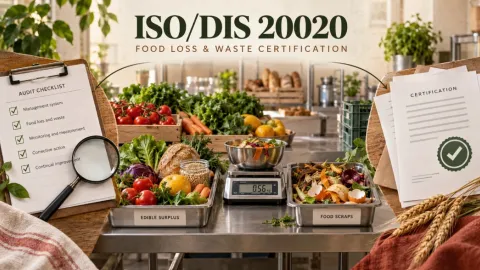
Comment Open on ISO/DIS 20020 for Bodies Auditing and Certifying Food Loss and Waste Management Systems
Comments are open on ISO/DIS 20020, a draft standard setting requirements for bodies that audit and certify food loss and waste management systems (FLWMS).