Management Systems World
All on Quality and other Standards in one place since 2010. Now Worldwide.
News
Please note that you have to be a registered member with paid membership in order to see full articles.
RegisterSelected News
Córdoba Event Maps Quality Infrastructure Needs for Circular Economy
The Center of Excellence on Innovation and Transformative Technologies for the Circular Economy (CEITTEC) hosted a regional meeting in Córdoba, Argentina,
KATS Expands GRP Certification for Disability Association
The Korea Agency for Technology and Standards (KATS) has expanded the Good Remanufactured Product (GRP) Certification held by the Korea Association for Information Technology of Persons with Disabilities (KADI), adding 64 remanufactured toner cartridge models to its existing certification.
Digital Product Passport at the Center of June PKN News
The Polish Committee for Standardization (PKN) has published the June 2026 issue of Wiadomości PKN, with the Digital Product Passport (DPP) at the center of the edition.
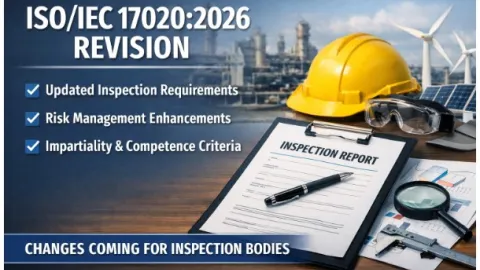
SNAS Publishes ISO/IEC 17020:2026 Transition Policy
The Slovak National Accreditation Service (SNAS) has published policy PL-64, outlining how accredited inspection bodies will transition to ISO/IEC 17020:2026, the international standard for inspection bodies.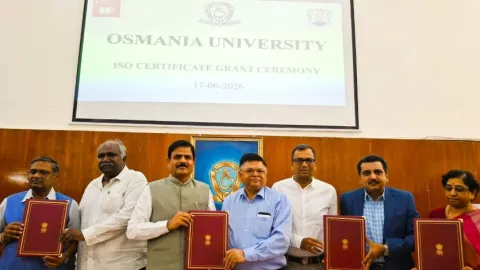
Osmania University Earns Four ISO Management System Certifications
Osmania University in Hyderabad, India, has earned four ISO management system certifications from the Bureau of Indian Standards (BIS), covering education, environmental management, energy management and food safety.
ECIJA Becomes First Spanish Law Firm Certified to ISO 42001
ECIJA Abogados has become the first law firm in Spain to achieve accredited certification to ISO/IEC 42001:2023, the international standard for artificial intelligence management systems.
Croatia Adopts ISO/IEC 17024:2026 for Certification of Persons
The Croatian Accreditation Agency (HAA) has announced the publication of HRN EN ISO/IEC 17024:2026,
CNAS Starts Trial Accreditation of Product Carbon Footprint Verifiers
China National Accreditation Service for Conformity Assessment (CNAS) has started trial accreditation of organizations that verify product carbon footprint data under CNAS-SV03:2026, which took effect on June 15, 2026.
German Cybersecurity Agency Favors ISO 27001 for Cyber Resilience Act Compliance
Germany's Federal Office for Information Security (BSI) has published TR-03183-H, a guideline that promotes ISO/IEC 27001 as the main framework for demonstrating compliance with the EU Cyber Resilience Act (CRA).
S&C 2035 Roadmap Charts Future of Standards and Conformance in Singapore
Enterprise Singapore has unveiled the Standards and Conformance (S&C) 2035 Roadmap,
UKAS Clarifies Status of BBA Accreditation Suspension
The United Kingdom Accreditation Service (UKAS) has confirmed that the British Board of Agrément (BBA) remains under suspension following action taken on February 26, 2026.
Cambodia Adopts More Than 50 Eurocodes
The Institute of Standards of Cambodia (ISC) is adopting more than 50 Eurocodes, the European standards used for the design of buildings and civil engineering works, with the national adoption process expected to be completed by June 2027.Global News

IFAN Launches Podcast Highlighting Perspectives Of Standards Users
The International Federation of Standards Users (IFAN), a global organization representing the interests of standards users, has launched a podcast aimed at sharing the experiences of organizations and professionals who use standards in their work.
ISO 25859 for Thermophilic Microorganisms in Dairy Under Development
The International Organization for Standardization (ISO) is developing ISO 25859, a new international standard that will define how microorganisms that grow at high temperatures are counted in milk and dairy products.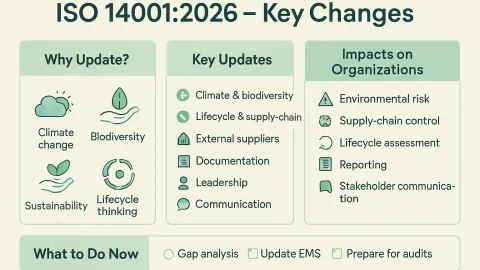
ISO 14001 Final Draft Approved For Publication
The Final Draft International Standard (FDIS) of ISO 14001 has been approved, paving the way for publication in mid April.
IATF Establishes Legal Entity, Ending Ad Hoc Structure
The International Automotive Task Force (IATF) has established a new legal entity, IATF AISBL, marking a shift from its previous structure as an ad hoc group of automotive manufacturers and their national industry associations.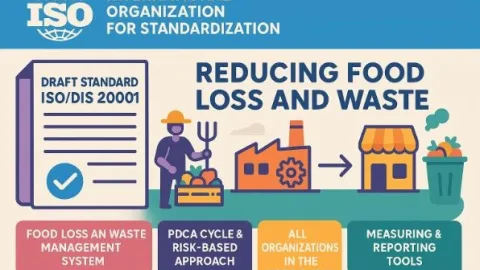
Have Your Say On Food Waste Management: ISO 20001 Survey
Harper Adams University is inviting professionals across the food chain to take part in a survey on ISO 20001, a proposed international management system standard designed to help organisations systematically reduce food loss and waste.
GOTS Version 8.0 Released With Expanded Due Diligence And Environmental Controls
Global Standard has released Version 8.0 of the Global Organic Textile Standard (GOTS),
Global Quality Infrastructure Index 2025 Report Ranks Germany First as Certification and Accreditation Expand
The 2025 edition of the Global Quality Infrastructure Index (GQII) has been released, presenting updated rankings and new data on the development of national quality infrastructure systems.
BRCGS Announces 2026 EMEA Award Winners At Connect Europe
BRCGS has announced its 2026 award winners during BRCGS Connect Europe in London, recognizing individuals and organizations serving the Europe, Middle East and Africa (EMEA) region and adjacent markets.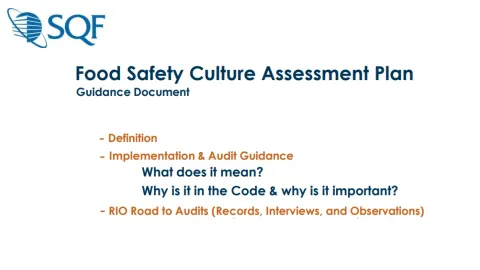
Food Safety Culture Becomes a Formal Certification Requirement Under SQF Edition 10
When SQF Edition 10 launches in March, food safety culture will be required and auditable as part of certification.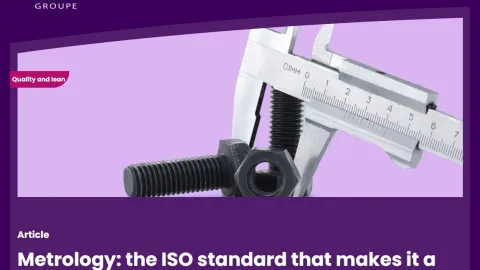
Revised ISO 10012 Reframes Metrology As A Management System
The revised ISO 10012 standard has been published, positioning metrology as an integral part of quality management systems rather than a standalone technical activity.
ISO 14091 Under Review To Ensure It Meets Climate Adaptation Needs
The International Organization for Standardization (ISO) is conducting a systematic review of ISO 14091 to determine whether it still meets the needs of organizations addressing climate change risks.