Management Systems World
All on Quality and other Standards in one place since 2010. Now Worldwide.
News Europe
Please note that you have to be a registered member with paid membership in order to see full articles.
RegisterSelected News
Czech Republic Adds Construction-Stage Requirements to BIM Data Standard
The Czech Standardization Agency (ČAS) has added construction-stage requirements to the country’s Construction Data Standard (DSS), specifying what information digital building models used in Building Information Modeling (BIM) must contain while a project is being built.
TÜV AUSTRIA Expands Railway Safety and Quality Services with Berlin Company
TÜV AUSTRIA has established TÜV AUSTRIA RAIL GMBH in Berlin, expanding its safety, testing and quality services for railway vehicles and infrastructure.
OECD Confirms Slovakia’s Good Laboratory Practice System Meets Requirements
The Organisation for Economic Co-operation and Development (OECD) has confirmed that Slovakia’s Good Laboratory Practice (GLP) monitoring system continues to meet its requirements, allowing qualifying study data from Slovak test facilities to remain internationally accepted.
Portugal Opens Nominations for 2026 Standardization Merit Award
The Portuguese Institute for Quality (IPQ) has opened nominations for its 2026 Standardization Merit Award, recognizing individuals who have made significant contributions to Portuguese standardization. Nominations close September 30.
FSC Responds to Concerns Over Romania’s Forest Certification
The Forest Stewardship Council (FSC) has published an FAQ following reports that raised concerns about Romania’s forests, addressing questions about protected forests, FSC certification and oversight in the country.
Winners Announced for the 2026 German Six Sigma Award
The European Six Sigma Club Germany (ESSC-D) has named the 2026 winners of its German Six Sigma Award for Business Excellence, recognizing university work and an industry project focused on process improvement.
FAST Components Europe Becomes Spain’s First Accredited Lab for Electronic Component Authenticity Testing
FAST Components Europe has become the first organization in Spain accredited by the Spanish National Accreditation Body (ENAC) to test the authenticity of electronic components in line with IDEA-STD-1010.
ISS Updates to Latest ISO 19011 Audit Guidelines
The Institute for Standardization of Serbia (ISS) has updated its management system audit guidance to ISO 19011:2026, with the latest edition now available in Serbian as SRPS EN ISO 19011:2026.
ISRSM Opens Public Consultation on ISO 45001 Draft Revision
North Macedonia has opened a public consultation on the draft revision of ISO 45001, with comments accepted until August 25, 2026.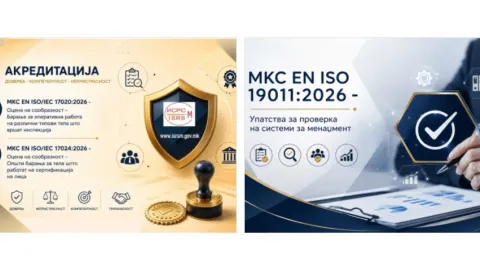
North Macedonia Adopts 2026 Editions of ISO 19011, ISO/IEC 17020 and ISO/IEC 17024
The Standardization Institute of the Republic of North Macedonia (ISRSM) has adopted national versions of three major 2026 standards covering management system auditing, inspection bodies and certification of people.
ISO/IEC 17020:2026 Transition Rules Published for Dutch Accredited Inspection Bodies
The Dutch Accreditation Council (RvA) has published ASR013, the mandatory transition document explaining how accredited inspection bodies must move from ISO/IEC 17020:2012 to ISO/IEC 17020:2026.
DIN Makes ISO 9002 Draft Available for Public Comment in Germany
The German Institute for Standardization (DIN) has made the draft of ISO 9002 available for free reading and public comment in Germany, giving quality professionals an opportunity to help shape guidance for implementing the revised ISO 9001 during the draft stage.Global News

Global ACI Sets 36-Month Transition for ISO/IEC 17024:2026
The Global Accreditation Cooperation Incorporated (Global ACI) has established a 36-month transition period for ISO/IEC 17024:2026, the newly revised international standard for bodies that certify individuals.
PAS 96:2026 Updates Food Defence Guidance for Emerging Threats
The British Standards Institution (BSI) has published PAS 96:2026, a fully revised edition of its food defence guide.
BRCGS Updates Meat Supply Chain Assurance Module
The British Retail Consortium Global Standards (BRCGS) has updated its Additional Module 11: Meat Supply Chain Assurance.
ISO 29997 Offers First International Framework for Quality Internships
ISO 29997:2025 provides the first international framework designed to help organizations deliver higher-quality internships through clearer planning, management and evaluation practices.
Experts Behind ISO 14001:2026 Explain New Focus on Climate, Biodiversity and Results
The International Organization for Standardization (ISO) has outlined the most important changes in ISO 14001:2026,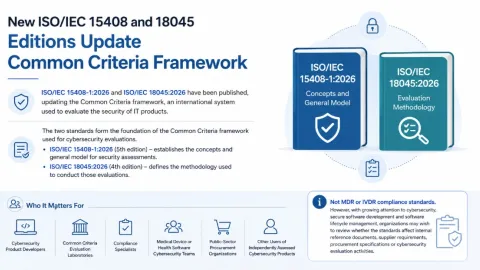
New ISO/IEC 15408 and 18045 Editions Update Common Criteria Framework
ISO/IEC 15408-1:2026 and ISO/IEC 18045:2026 have been published, updating the Common Criteria framework, an international system used to evaluate the security of IT products.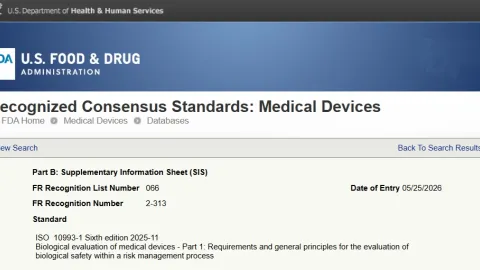
FDA Partially Recognizes ISO 10993-1:2025 for Medical Devices
The U.S. Food and Drug Administration (FDA) has partially recognized ISO 10993-1:2025, the latest edition of the international standard used to assess the biological safety of medical devices.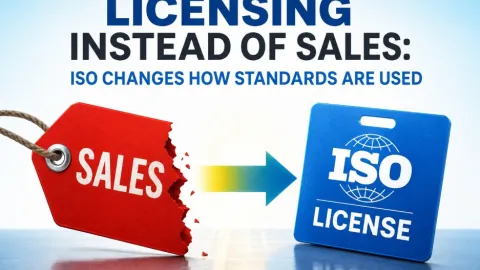
Licensing Instead of Sales: ISO Changes How Standards Are Used
The International Organization for Standardization (ISO) is preparing to replace its traditional standards sales approach with a licensing model that would give users defined rights to use standards content instead of broad unrestricted access.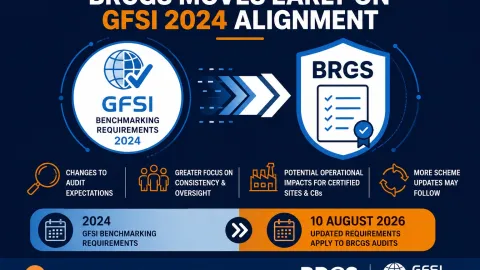
BRCGS Updates Food Safety, Packaging, Storage, and Broker Rules to Meet New GFSI Requirements
BRCGS has updated certification requirements for its Food Safety, Packaging Materials, Storage and Distribution, and Agents and Brokers standards,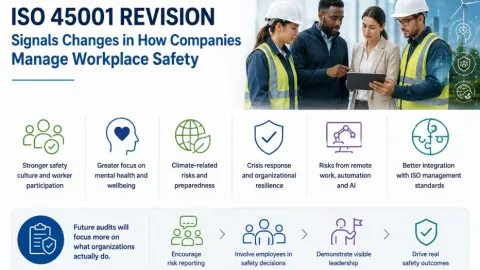
ISO 45001 Revision Signals Changes in How Companies Manage Workplace Safety
The revision of ISO 45001 is expected to push companies beyond traditional workplace safety management by placing greater emphasis on mental health, organizational resilience, safety culture, and climate-related risks.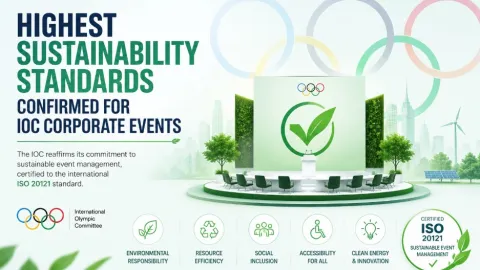
International Olympic Committee Certified to ISO 20121 Event Sustainability Standard
The International Olympic Committee (IOC) has been re-certified to ISO 20121:2024 for sustainability management at the corporate events it directly organizes and finances, including IOC Sessions, conferences, Olympic Day activities, and commission meetings.