
Management Systems World
All on Quality and other Standards in one place since 2010. Now Worldwide.
News Medical Products & Pharmaceuticals
Please note that you have to be a registered member with paid membership in order to see full articles.
RegisterSelected News

EA Introduces Mutual Recognition for Biobank Accreditation Under EN ISO 20387
European co-operation for Accreditation (EA) has introduced mutual recognition for biobank accreditation under EN ISO 20387, with six accreditation bodies becoming the first signatories.
RvA Gains European Recognition for EN ISO 20387 Biobank Accreditation
The Dutch Accreditation Council (RvA) has gained European recognition for its EN ISO 20387 biobank accreditation activity, after the standard was added to its European co-operation for Accreditation (EA) Multilateral Agreement (MLA) scope.
NIST and NIH Seek Input on Future Medical Measurement Standards
The U.S. government is seeking public input on future measurement and standards needs for medical imaging, devices, diagnostics and therapy.
Erasmus MC Receives Netherlands’ First Biobank Accreditation
The Dutch Accreditation Council (RvA) has granted the Netherlands’ first biobank accreditation to Erasmus MC Central Biobank & Trialsupport.
Saudi Arabia Takes Secretariat of New ISO/TC 357 on Wound Dressings
Saudi Arabia will hold the secretariat of the newly created International Organization for Standardization (ISO) technical committee ISO/TC 357, which will develop international standards for wound dressings and compresses.
NEN Invites Stakeholders to Shape Standards Agenda for Sustainable Medical Devices
The Royal Netherlands Standardization Institute (NEN) is inviting healthcare organizations, manufacturers, government bodies, researchers and other stakeholders to help develop a national standardization agenda for sustainable medical devices.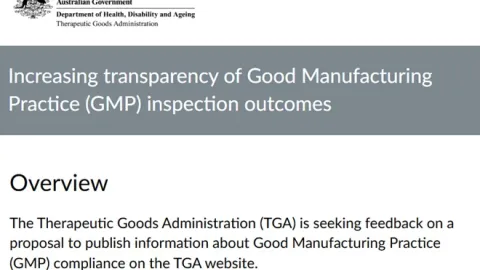
TGA Proposes Publishing Therapeutic Goods GMP Inspection Outcomes
The Therapeutic Goods Administration (TGA) has opened a consultation on plans to publish Good Manufacturing Practice (GMP) inspection outcomes and GMP certificates for therapeutic goods manufacturers, seeking feedback on how the information should be published and accessed.
Norway Reestablishes Medical Device Standards Committee, Invites New Members
Standard Norway (SN) has reestablished its national committee for medical device management systems and is now inviting more professional communities to participate in work on international and European standards for quality and risk management in medical devices.
PCA Opens Consultation on Revised Biobank Accreditation Program
Polish Centre for Accreditation (PCA) has opened a public consultation on a revised version of its DABB-01 accreditation program for biobanks, introducing clearer rules for accreditation scope descriptions and updates aligned with PN-EN ISO 20387:2021-01.
Vietnam Food Safety Institute Achieves GLP-OECD Status
The National Accreditation Office for Quality (BOA) awarded OECD Good Laboratory Practice (GLP) recognition to the National Institute for Food Control (NIFC),
Dutch Initiative Prepares New Committee on Medical Device Environmental Impact
The Royal Netherlands Standardization Institute (NEN) is preparing a new committee focused on methods for assessing the environmental impact of medical devices, with the aim of helping shape Dutch input into future European and international standardization work.
Mexico Updates Medical Device Labeling Standard With New Safety and Digital Information Rules
Mexico’s Ministry of Health has published a revised version of NOM-137-SSA1-2024, the national standard that sets labeling requirements for medical devices sold in the country.Global News
FSSC 22000 Version 7 Achieves GFSI Recognition Under 2024 Requirements
FSSC 22000 Version 7 has achieved recognition against the GFSI Benchmarking Requirements Version 2024, Foundation FSSC announced on November 11, 2026.
Ford Restores Earlier PFMEA and Control Plan Approval Rules for SCCAF Programs
Ford has restored the PFMEA and Control Plan approval requirements that applied before its June 2026 update for programs using the Special Characteristics Communication and Agreement Form (SCCAF).
ISO Approves Two Travel Risk Management System Projects
ISO has approved two projects to develop travel risk management system requirements: ISO/AWI 31032 for organizations and ISO/AWI 31033 for travel service providers.
FSC Consults on Cultural Ecosystem Services and Updates Transitional Claims Rules
FSC has opened consultation on proposed changes to its Ecosystem Services Procedure, while separately introducing a transitional mechanism for claims from existing projects.
ISCC PLUS Consults on Fuel-Use Excluded Attribution Add-on
ISCC has opened consultation on an ISCC PLUS add-on for fuel-use excluded attribution, a mass-balance option governing allocation of sustainability attributes across certified supply chains.
Global ACI and ISCC Formalize CORSIA Scheme Endorsement
Global ACI and ISCC have signed an endorsed scheme agreement for ISCC CORSIA, adding an implementation milestone to the earlier recognition decisions.
Rainforest Alliance Level A Sites Move to Independent Remote Audits
Rainforest Alliance is replacing endorsement letters with third-party remote audits for Level A supply-chain sites.
ISO 56005 Intellectual Property Guidance Revision Enters Committee Draft
The revision of ISO 56005 has reached committee-draft registration, advancing work on intellectual property guidance within innovation management.
Global ACI Sets Transition Periods for Revised ISO/IEC 17065 and ISO 20387
Global Accreditation Cooperation Incorporated (Global ACI) has agreed transition arrangements for the forthcoming revisions of ISO/IEC 17065 and ISO 20387, alongside decisions extending its international recognition framework to two sustainability-related schemes.
ISO 14025:2026 Strengthens Verifier Independence and Clarifies When EPDs Can Be Compared
The second edition of ISO 14025 strengthens independence requirements for verifiers of environmental product declarations (EPDs) and clarifies when those declarations can be compared.
ISO 22316 Organizational Resilience Revision Reaches Final Approval
The revision of ISO 22316, the international guidance on organizational resilience, entered stage 50.20 of the final approval process on October 30, 2026.