Management Systems World
All on Quality and other Standards in one place since 2010. Now Worldwide.
News Medical Products & Pharmaceuticals
Please note that you have to be a registered member with paid membership in order to see full articles.
RegisterSelected News

Inmetro Opens Pilot Accreditation Program for Brazilian Biobanks
The National Institute of Metrology, Quality and Technology (Inmetro) has opened applications for a pilot accreditation program for biobanks in Brazil based on ISO 20387.
Accredia Passes EA Peer Evaluation for Biobanking Accreditation
The Italian accreditation body Accredia has passed a peer evaluation by the European co-operation for Accreditation (EA), advancing the process for international recognition of Italian biobank accreditations under ISO 20387.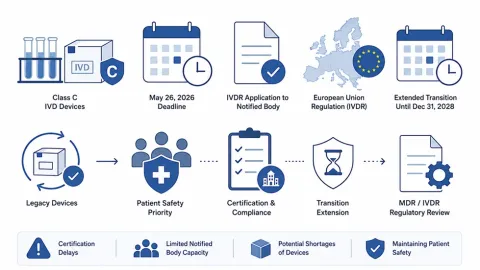
IVDR May 26 Deadline Closes In for Class C Diagnostic Device Manufacturers
Manufacturers of medium-to-high risk Class C in-vitro diagnostic medical devices (IVDs) face a May 26, 2026 European Union deadline to formally apply under the In Vitro Diagnostic Medical Devices Regulation (IVDR).
WMDA Earns Accreditation for Global Stem Cell Donor Certification
The World Marrow Donor Association (WMDA) has been accredited by the Dutch Accreditation Council (RvA), allowing the organization to certify stem cell donor registries and transplant coordination services under internationally recognized requirements.
Cofrac Updates Map Of Accredited Medical Biology Laboratories In France
The French Accreditation Committee (Cofrac) has released an updated map showing the distribution of accredited medical biology laboratories (LBM) across France as of April 1, 2026.
China Updates Laboratory Accreditation Rules for Medical Device Testing
China National Accreditation Service for Conformity Assessment (CNAS) has issued a revised version of its guidance for applying laboratory accreditation criteria in medical device testing, with CNAS-CL01-A004:2026 set to take effect on May 1, 2026.
China Tightens GMP Rules For Medical Device Manufacturers Effective November 2026
The National Medical Products Administration (NMPA) has revised China’s Good Manufacturing Practice (GMP) requirements for medical devices, introducing stricter quality management system rules that will take effect on November 1, 2026 and replace the current 2014 version.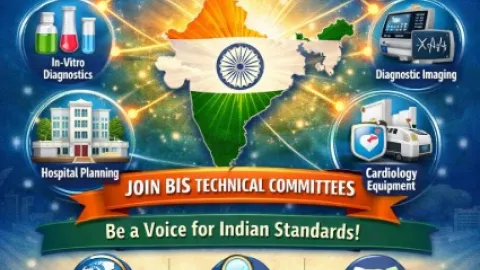
India Invites MSMEs to Join Healthcare Standards Committees
The Bureau of Indian Standards (BIS) is inviting micro, small, and medium enterprises (MSMEs) to join technical committees in its Medical Equipment and Hospital Planning Department (MHD), opening the standardization process to a wider range of industry participants.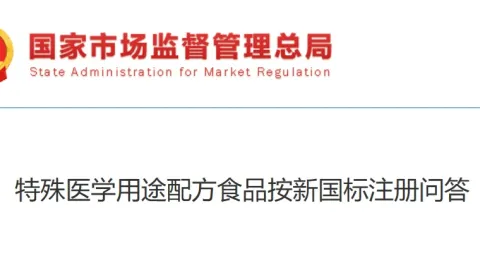
China Clarifies Registration Rules for Special Medical Foods Under New Standards
The State Administration for Market Regulation (SAMR) has issued a Q&A to explain how foods for special medical purposes (FSMP) should be registered under China’s updated national standards, helping companies understand how to apply the new rules in practice.
AKH Wien Becomes First Hospital In Austria Certified For Diversity Management
The Vienna General Hospital (AKH Wien) has become the first hospital in Austria to receive certification for its diversity management system,
FDA Schedules Town Hall On Risk Based Inspections Under New QMSR Framework
The U.S. Food and Drug Administration (FDA) has announced a Town Hall on April 1, 2026, to explain how inspections of medical device manufacturers will change under its new Quality Management System Regulation (QMSR), with a focus on a risk-based approach.
FDA Shifts Medical Device Inspections To Lifecycle-Based QMS Oversight
The U.S. Food and Drug Administration (FDA) has updated how it inspects medical device manufacturers, introducing a lifecycle‑based approach to quality management system oversight under its new Quality Management System Regulation.Global News
Global ACI Sets Three-Year Transition Timelines for ISO 14001:2026 and ISO 9001:2026
Global Accreditation Cooperation Incorporated (Global ACI) has set three-year transition periods for accredited certification to ISO 9001:2026 and ISO 14001:2026 , ending September 30, 2029 and April 30, 2029, respectively.
China Approves World’s First Medical Device Standard for AI Brain-Computer Interfaces
China has approved YY/T 2029-2026, the world’s first medical device standard for brain-computer interfaces (BCIs) that use artificial intelligence (AI).
IFS Makes EU Packaging Rules Self-Assessment Tool Available After 70-Company Pilot
International Featured Standards (IFS) has made its self-assessment tool for the EU Packaging and Packaging Waste Regulation (PPWR) available in the IFS Database after a pilot involving 70 companies.
Comment Open on ISO/DIS 20020 for Bodies Auditing and Certifying Food Loss and Waste Management Systems
Comments are open on ISO/DIS 20020, a draft standard setting requirements for bodies that audit and certify food loss and waste management systems (FLWMS).
ISO Begins Developing IWA 52 to Harmonize Transport GHG Emission Factors
The International Organization for Standardization (ISO) is developing IWA 52 to harmonize how greenhouse gas (GHG) emission factors are calculated for transport.
ISO 22095-1 Chain of Custody Revision Reaches Committee Draft Stage
ISO 22095-1 has reached the Committee Draft stage, moving the revision of the general chain of custody framework into formal consultation.
IATF Clarifies Complaint Handling for Certification Bodies
The International Automotive Task Force (IATF) has issued new guidance for certification bodies on handling vehicle manufacturer performance complaints through the IATF Complaint Management System (IATF CMS).
How SBTi and GHG Protocol Updates Expand Options for Corporate Emissions Accounting
Changes from the Science Based Targets initiative (SBTi) and Greenhouse Gas Protocol, two major frameworks for corporate climate targets and greenhouse-gas accounting, are expanding the options companies have for addressing and accounting for value-chain emissions.
ISO 9001:2026 Officially Launched
The sixth edition of ISO 9001, the world’s most widely used quality management system standard, has been officially launched by ISO during a virtual press conference.
Global Responsible Textile Standard (GRTS) Launches for Certification of Wider Range of Fibers
Global Standards has launched the Global Responsible Textile Standard (GRTS), a new certification standard for textiles made from a wider range of plant, animal, synthetic, man-made cellulosic and recycled fibers.
ISO 45001 Second Edition Clears DIS Ballot With Overwhelming Support
The draft second edition of ISO 45001 has passed its Draft International Standard (DIS) vote with only one vote against, moving the revision closer to its planned publication in the first half of 2027.